As part of their curriculum, a group of Civil Engineering majors spent the day at “The Sweetest Place on Earth,” learning how to take their knowledge and skills beyond the classroom into running amusement parks.
On Saturday, August 29, 2026, a group of Civil Engineering students traveled down from York College of Pennsylvania to spend the day at a famous landmark in Hershey, Pennsylvania – Hersheypark, one of Pennsylvania’s largest amusement parks. Thanks to the generosity of a donor who funded the trip, the students had the opportunity to tour the family theme park and take a closer look at how what they are learning in their classes can be translated specifically to their roller coasters.
Professors from the Civil Engineering Department agreed that a behind-the-scenes experience would be a fun way to engage the students in their studies. Seeing how the rides were designed, operated, and maintained would be especially helpful in showing that engineering can take many forms and lead to unexpected builds.
“Our hosts and guides for the field trip were civil engineers, and it was important for the students to understand just how broad and applicable their education here at YCP is and can be,” said Dr. Josh Wyrick, Associate Professor of Civil Engineering and one of the organizers of the day trip.
Securing Ride Safety
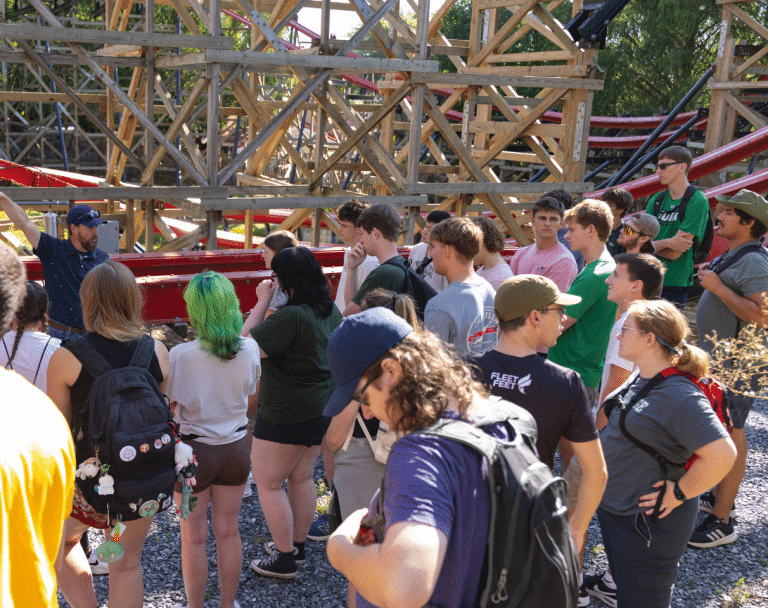
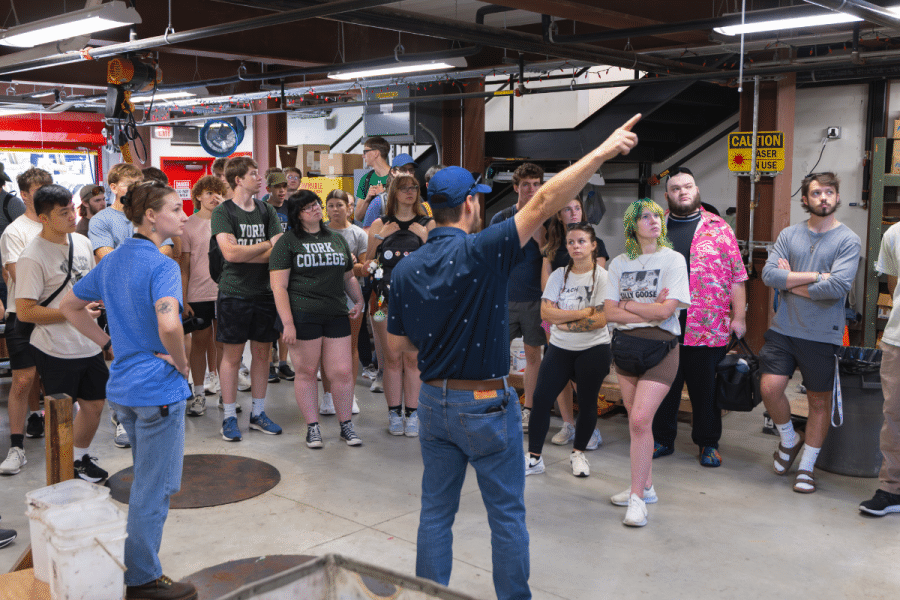
The main focus of the trip was to get a closer look and better understanding of how the various roller coasters in the park function. Led by their head and assistant engineers, the students got to see much of the internal workings of the rides and how they run.
Not only did they get to see where the rides are repaired, painted, and tested, but they also learned the importance of keeping everything up to date. Safety is always a top priority, so the rides are tested before every park opening.
One of the main attractions the students visited was the SooperDooperLooper roller coaster. The students toured the coaster and learned about its ongoing renovations, which aim to rebuild the original structure built in 1977.
“Part of the issue is that a lot of the electronics are in the floodplain, so they’re rebuilding it so when there is a flood, most of those things shouldn’t get damaged,” said Kayla Reidenbaugh ‘28. “So we got to hear everything that went into getting permits, and going into the design of the new structure, which was really cool.”
Kayla became a Civil Engineering major because of her love of mathematics, building, and design. Her fascination grew as she learned more about how that field allowed engineers to create builds that could have long-lasting impacts on the community. So seeing how that knowledge could be applied to roller coasters and every detail of their designs needed to consider their riders and environment piqued her interest during the trip.
Especially after a previous field trip to the York Water Company, an internship at Butler Manufacturing, and learning about topics in class such as structural analysis in buildings, Kayla could better visualize and apply what she learned to the renovations being done to the SooperDooperLooper and understand why certain details were important to address.
“Going to these out-of-classroom experiences allows me to connect better to concepts and helps me remember more because I know how they can be applied,” Kayla said.
Hydraulics Up Close
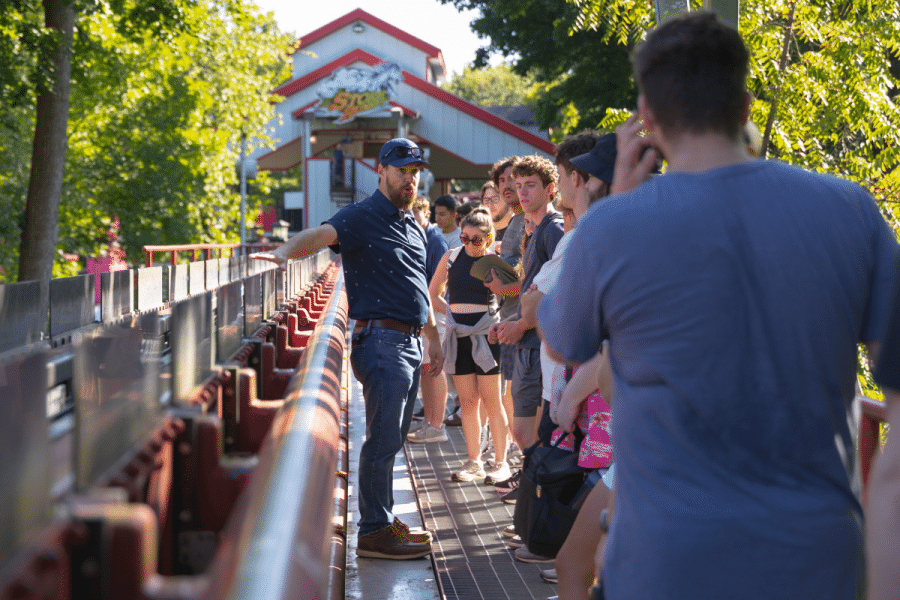
Another ride the group visited was Storm Runner, a hydraulic-launch coaster capable of launching riders from zero to more than 70 miles per hour in just a few seconds. Specifically, they were shown just how much hydraulic power is required to generate the speed and force that create the rush riders experience in the first few seconds of the ride.
“It was very cool because we went up and we were given access to the inner control room and the electronics of the hydraulic launch and all the systems in there,” said Christopher (CJ) Farrant ‘29, another Civil Engineering major on the trip.
For CJ, engineering was always an interesting field to explore, especially when it came to understanding the mechanics of larger buildings and machines and how each component contributed to their functioning.
Having grown up in New Jersey, CJ was familiar with the rides at Six Flags Great Adventure amusement park and the hydraulic-launch coaster they used to have. He was surprised to learn that Storm Runner’s systems are similar to those of the other coaster, but are actually twice as big.
The students learned how hydraulic machines can support their riders' weight and calculate the tension required to reach the coaster's appropriate velocity. Everything in the room control room, even the air conditioning, must be working properly, or the ride will not launch. Safety precautions are the most important component to be addressed when handling hydraulic coasters. This is why many individual parts of the ride are replaced with each operating season, even if the pieces are relatively new.
Like with Kayla, seeing what he learned firsthand applied in an unexpectedly fun environment was an eye-opening experience for CJ. Witnessing how his classes relate to the real world was a valuable experience for him, especially when they emphasized how to balance fun and safety in attractions. It makes him excited to work on his own builds in the future.
“This experience has helped my journey through just being able to see the real-world applications of a lot of the things we’re learning…” said CJ. “It’s just cool because again, you get to see how everything was built.”
Being A Part of the Building Process
Sean Riley ‘27 became a Civil Engineering major because of his love of LEGOs and building as a kid. Not only was his father an engineer, but he also worked at LEGOLAND under a LEGO Master Model Builder, who shared that his own career path began with an engineering degree.
His roots inspired him to see engineering in a completely different light. Having the opportunity with his fellow classmates to explore how engineering can be taken into the entertainment field further heightened his interest.
“My goal is to be a structural engineer,” Sean said. “I want to work with structures, primarily bridges, but seeing how the roller coasters are built, the foundations, the way they use angles and point loads, is so fascinating.”
The hands-on experience Sean and the other Civil Engineering students had truly showed them what it meant to go beyond the classroom and to see the skills they learned put to use in the real world. Building roller coasters and similar rides requires the same care and precision as constructing buildings and bridges. All while also considering the environments they are constructed around.
Even for students who haven’t completed their co-ops yet, seeing the different ways they can use their knowledge and find a role they can fill makes branching out an exciting yet valuable experience. And for those who have already worked for a short time in the engineering world, being part of the creation or building process of a product or machine for a business can reinforce everything they have learned.
“I think you do learn the most when you’re out in the field,” Sean said. “I think it also applies to our co-ops when we’re actually, physically, working under a professional engineer, getting advice, being thrown in the deep end, really helps us learn a lot. I think being able to get these experiences and having these trips, such as Hershey, allows us to see what we do in class be applied in real life. It’s a tangible experience we can put ourselves in their shoes and imagine ourselves there.”
“My goal was to expand their horizons,” Dr. Wyrick said. “Sure, many civil engineers work on bridges, and warehouses, and housing developments. But they also design the supports for roller coasters, and do hydraulic modeling of creeks to know which parts of the rides would be inundated during a flood, and analyze traffic patterns to know how to efficiently move visitors through large parking lots, and design pump and pipe systems to keep the lazy river flowing, and maintain treatment systems to keep the water in the wave pool clean.”
Understanding the science behind creating the magic at amusement parks is truly an unforgettable experience for those passionate about engineering. And thanks to the excursion to Hersheypark, York College’s future engineers have had their horizons expanded to recognize that there are truly endless possibilities of where they can find their careers.