In the heart of York, Pennsylvania, history isn't just buried in dusty archives.
Our history is at the center of local policy, actively shaping the laws, neighborhoods, and lives of the people who call this city home.
Powered by a grant from the Graham Center for Collaborative Innovation (GCCI), Dr. Corey Brooks (Policy and History in York, Pennsylvania, HIS/PS 463) and Dr. Michael Zerbe (Editing and Style, WRT 410) are pairing rigorous historical policy research with high-level professional editing. Together, they are building an interdisciplinary, repeatable framework designed to sustain these community-engaged courses for years to come.
Since its debut in 2019, York College of Pennsylvania’s HIS/PS 463: Policy and History in York, Pennsylvania course has bridged academic rigor and civic engagement, transforming standard undergraduate research into actionable public policy insights. Built around an experiential model inspired by the American Historical Association’s (AHA) Congressional Briefing program, the course challenges students to dig into local primary sources and tackle pressing regional issues — ranging from poverty in 2019 to housing equity in 2022. The semester culminates in a formal public briefing at the Center for Community Engagement’s (CCE) downtown space, where students present their findings directly to local policymakers, including the Mayor of York, state legislative staff, and regional nonprofit leaders.
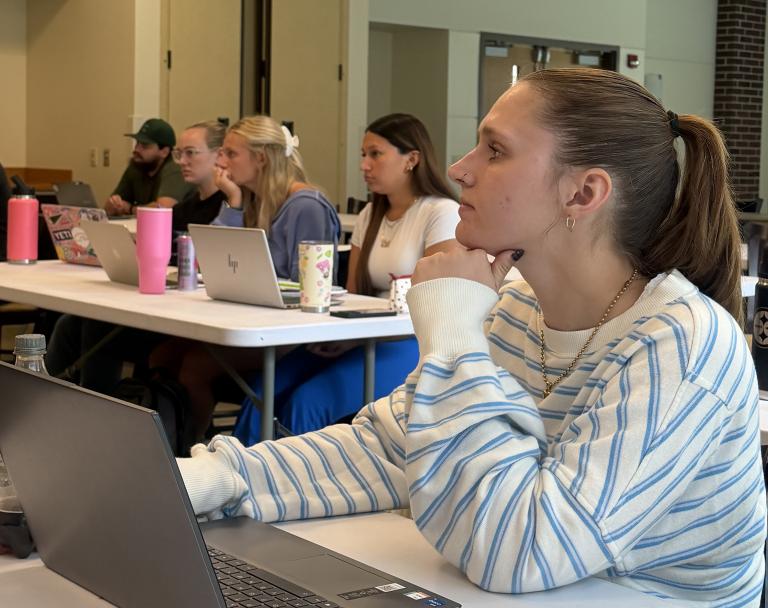
“This is a research-intensive, community-engaged course in which students research the local historical context relevant to policy challenges currently faced by the York community,” explained Dr. Brooks. “Each semester, the students enrolled conduct original local policy history research on individual topics linked to a shared policy issue.”
The newly awarded GCCI grant aims to ensure that these student insights leave a lasting mark in York while creating a sustainable and replicable model for faculty interested in incorporating community-based projects in their courses. Through the grant, the department will establish a cross-disciplinary framework alongside the CCE and the Arthur J. Glatfelter Institute for Public Policy (AJGIPP). By utilizing the Glatfelter Graduate Scholar-in-Residence to assist with research coordination and experimenting with group research structures, the initiative will build an efficient, repeatable model that leverages existing YCP resources to support instruction.
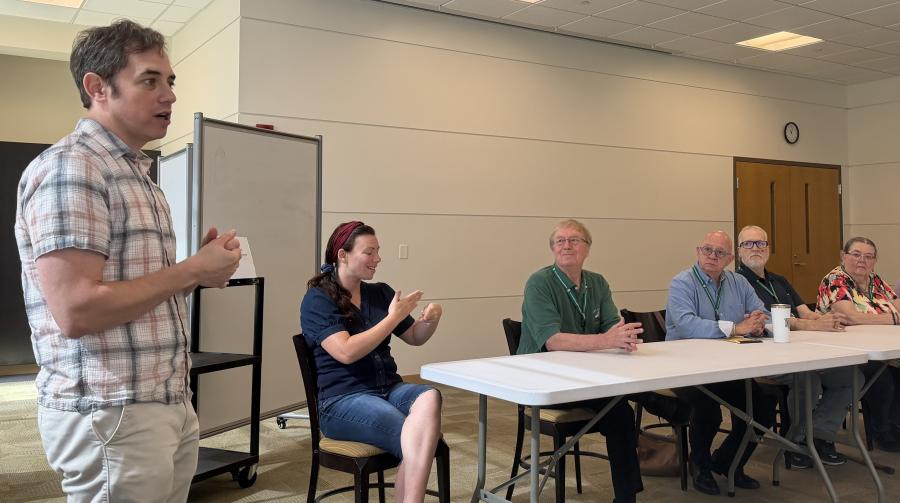
The new course has directed its research lens toward the history of policies surrounding aging in the York region. This focus coincides with the launch of York College’s Lifelong Learning Initiative (LLI) and aligns with broader regional initiatives, including the York County Community Foundation’s Embracing Aging Initiative. Students enrolled in the course will not only analyze archival policy decisions but also collaborate directly with LLI members to conduct oral histories to capture lived experiences as primary historical sources. “This semester, students are focusing on policies related to aging. After completing their original research, students work together to distill their findings into an hour-long briefing that is then presented to policymakers and other stakeholders in our community,” said Dr. Brooks.
In support of this effort, Dr. Brooks has also partnered with Dr. Zerbe to engage his writing students in peer editing and feedback and to help adapt messaging for different audiences. Dr. Zerbe’s class, Editing and Style, has students enrolled in copyediting, comprehensive editing, and the analysis and production of various prose styles. By the end of the semester, the goal is for students to demonstrate the ability to negotiate editing goals with writers and apply effective editing strategies to achieve those goals. “Students in the English and Writing major need a course that focuses on language use at the word and sentence levels, and that broadens their repertoire of writing styles,” explained Dr. Zerbe. “The course really helps students take ownership of language and builds their confidence as language experts.”
Ultimately, the collaboration between Dr. Brooks’ researchers and Dr. Zerbe’s editors bridges a crucial gap in higher education: translating complex, evidence-based research into a clear, persuasive narrative for the public square. By combining historical inquiry, oral histories, and refined prose, York College students are actively enriching local policy discourse surrounding critical issues such as regional aging. Beyond the immediate impact this semester, the ultimate promise of the GCCI funding lies in its longevity. Rather than treating community engagement as a one-off experiment, this initiative establishes a structured, repeatable framework using existing YCP assets. As this repeatable model takes root, YCP is not only empowering future historians and writers with real-world skills but also establishing a lasting academic tradition that keeps the college deeply invested in the civic vitality of York for years to come.