Students spent a semester creating materials to help the York-based nonprofit, which blends food, culture, and community, to communicate more effectively with its various audiences.
Professor Gabriel Cutrufello, Ph.D., Chair of York College of Pennsylvania’s Department of Communication and Writing, has long held that courses that allow students to address a community need have a deeper impact on their education. For more than a decade, he has connected students with community partners through his Document Design course, which introduces students to basic visual design language and programs.
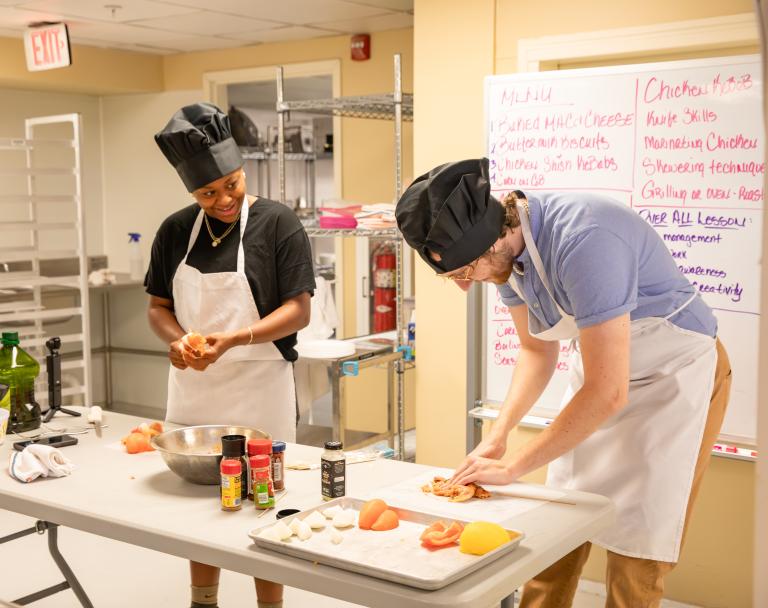
Throughout the 2026 Spring Semester, students worked with Cooking Up Connections, a York-based nonprofit founded by Liz Morales that uses culinary arts to help youths build a sense of belonging and leadership skills.
Designing for a real mission
The class included 24 students from a variety of majors, including Sport Management and English and Writing. Their task was to create materials to help Cooking Up Connections communicate its mission more clearly to multiple audiences. Students designed a prospectus, a multicultural cookbook template, a cohort yearbook template, a slide deck template, a branding guide, and a grant application template.
“This is one of my favorite classes to teach,” Dr. Cutrufello says. “It gives a true purpose for learning the design software, design language, and workflows.”
Before students even opened software such as InDesign, Canva, Photoshop, or Google Docs, they had to understand the people and purpose behind the project. They began by studying existing client materials, learning basic design concepts, and analyzing what procedures the nonprofit had in place. Midway through the semester, they interviewed Morales, wrote analysis and recommendation memos, and developed rough drafts. They presented finished materials to Morales during finals week.
From their research and the interview, students learned that the materials they designed needed to speak to potential funders, hiring managers, students, parents, and program participants while reflecting the organization’s larger emphasis on connection and community. Even color choices mattered because the program serves individuals from many cultural backgrounds.
Students also completed basic Google Project Management training through the York College Career Academy. This offered another tool for working through a team-based project from start to finish, as well as a certification to include on their resumes.
Learning to serve the client
The assignment pushed students to think beyond whether their professor liked a design. Dr. Cutrufello often reminded them that the client, not the instructor, is the primary audience. Students had to consider not only how a piece looked but also whether it solved a specified problem.
“What they’re really learning how to do is make decisions,” Dr. Cutrufello says.
A polished design created with professional software was not always the best solution when Cooking Up Connections needed a template that could be easily updated in its everyday workflow. In some cases, the strongest materials were built in Google Docs because they were practical and easy for the client to use.
“Knowing that a real nonprofit might actually use what we created made me take the work more seriously,” says Mass Communication major Makayla Fermin ’27. “It also gave me something I can confidently bring up in interviews because it shows I’ve already worked with a real client and handled hands-on projects with real users.”
Angelina Wilson ’28, an English and Writing major, says working with Cooking Up Connections gave her design work a deeper sense of purpose.
“I wanted to do a good job for the young people learning how to cook and for the adults guiding them along the way,” she says. “I wanted to learn how to use my document design skills to the fullest extent, so real clients were a great intrinsic motivator for me.”
Firsthand experience with community impact
The project highlighted York College’s emphasis on experiential learning and community engagement by asking students to work in teams with a client, meet deadlines, process feedback, and match their product to the needs of the client.
“The big thing is for the students to get that this is what professional careers look like,” Dr. Cutrufello says. “They’ll always be collaborating for external or internal clients, and the work will be project-based more than task-oriented.”
By the end of the semester, students had built elements for their portfolios, practiced client communication, and contributed useful tools to a local nonprofit.
“York has given me so many hands-on opportunities that actually feel connected to the real world, not just the classroom,” Makayla says. “Projects like this one, where you work with real clients, real missions, and real community impact, are great experiences all around.”